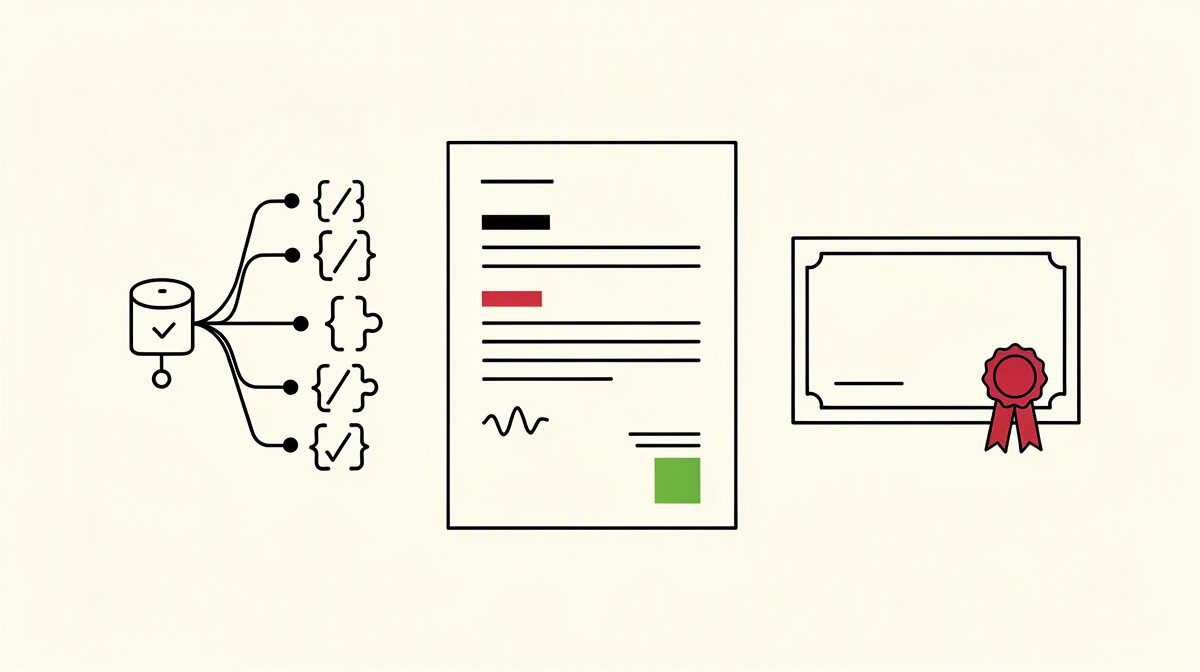
Hiring remote developers is challenging when in-person meetings, on-site trial work and spontaneous team impressions are missing. Competence then has to be assessed in a different, reliable way. CVs, references, employment references and interviews remain useful, but in distributed hiring they are often not enough to assess actual development work with confidence.
The key question is therefore:
- Which indicators show technical substance, care and independent contribution at a distance?
This article shifts the focus from self-description to verifiable work from real day-to-day development. It provides a practical framework for companies hiring remote developers or building distributed teams.
Why remote hiring needs different evidence
Distance changes how companies can assess candidates. When in-person meetings, shared office routines or spontaneous follow-up questions disappear, many small impressions that would otherwise feed unnoticed into decisions are lost. That is precisely why what can be traced and verified becomes more important.
In development work, the visible result is also rarely just the finished code. What matters as well is,
- how changes come about,
- how they are documented,
- how carefully risks are safeguarded,
- and how well the work remains usable for others.
A remote selection process should therefore not rely too heavily on appearance, eloquence or confidence in conversation. A good interview remains useful, for example for understanding someone’s thinking, communication and priorities. But even questions in a telephone interview tend to show more how someone formulates answers than what real development work looks like in a project context.
In distributed teams, there is the added factor that collaboration is often asynchronous. That increases the importance of independence, clean handovers and technical care. Anyone working remotely leaves traces not only in the result, but also in how work is prepared, described and safeguarded.
CVs, references and interviews therefore remain sensible, but they should be put into context rather than overstated. Formal evidence can provide context; at the same time, it shows only part of what it can actually do and where its limits lie.
For technical assessment, more concrete signals are therefore often more helpful, as also becomes apparent in the assessment of developer work. These traces are usually most visible where real work has been done: in the repository.
What traces real development work leaves in Git
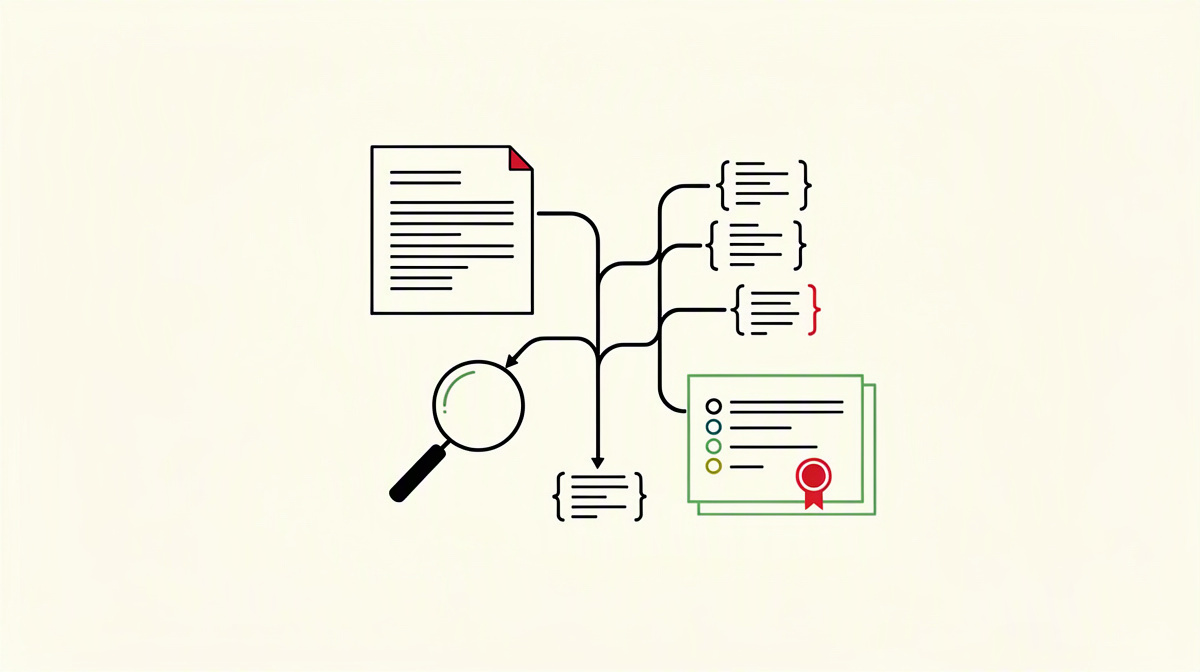
A Git repository shows more than the current state of a project. It also documents how changes came about over time. That is exactly what makes repositories interesting for remote hiring: not only the outcome becomes visible, but also the path that led to it.
Various traces can be relevant here:
- commit histories
- change rhythms
- the structure of individual contributions
- the distribution of changes over time and across areas of the code
Such signals allow conclusions about how someone works and what share a person had in concrete results. What matters is not a single commit, but the pattern that emerges from many changes.
This is where Stage A comes in: the Ghostwriter Detector. It analyses the .git history forensically. It checks,
- who authored commits,
- whether code was dumped in large blocks,
- and what Impact Score can be derived from the history.
This view is particularly useful for distributed hiring. When companies do not experience candidates in their day-to-day working context, the history helps distinguish independent contribution from mere presentation more clearly, without relying solely on what is said in an interview. Anyone who wants to assess development credibly therefore needs reliable traces from real work rather than just a good summary of it.
Context matters here too: what is evaluated are patterns in the history, not hasty conclusions from isolated observations. A single commit says little. Only across multiple contributions does it become clear whether work appears consistent, traceable and genuinely self-produced.
Related artefacts can also help. If you want to understand collaboration in code context more closely, you can, for example, read pull requests more closely. Issues, descriptions and handovers can also provide additional clues when technical work is being assessed in a team context.
Checking security, quality and care without live coding
When hiring remotely, it is not enough simply to establish whether someone can write working code. Equally important is how risks, maintainability and technical safeguards are handled in day-to-day project work. In distributed teams especially, care often shows up not in a single answer, but in the traces left by real work.
For this, Stage B looks at the Safety Check. It scans a repository for four points:
- leaked secrets
- known vulnerabilities in dependencies
- test coverage
- the tech stack
These four perspectives matter to companies because they show whether fundamental security and quality questions were taken into account in real development work. People who work carefully often leave behind not only features, but also signs that risks were recognised and limited.
Test coverage is not, however, a complete judgement on quality. On its own, it does not show whether code is well designed, understandable or robust. As a contextual factor, it is still useful because it can help indicate how seriously safeguards are maintained in everyday work.
Looking at dependencies and known vulnerabilities is particularly important in remote hiring. In distributed teams, risky legacy issues often only become apparent later, when handovers have already taken place or responsibility is spread across several people. Early visible traces of such risks therefore help when assessing technical care.
This usefully complements what interviews reveal. Someone may explain security concepts correctly or speak thoughtfully about prompt engineering for developers and still leave untidy patterns in the repository. Conversely, even small routines often point to a sense of responsibility, such as local safeguards, consistent checks or care before the commit.
Turning individual signals into a verifiable overall judgement

After history, security features and quality indicators, Stage C provides a condensed assessment. For this, a panel of five AI expert personas evaluates the results from the previous stages. The five perspectives are:
- Tech Lead
- Security
- Performance
- Architect
- Craftsman
Importantly, these personas do not provide five separate final judgements. They arrive at a shared Consensus Verdict. This Verdict appears together with a Confidence Score and should therefore not be read as absolute certainty, but as a documented assessment based on the signals that were checked beforehand.
For companies, this format is useful because it condenses technical complexity without obscuring where the assessment comes from. The evaluation does not stand on its own, but is built on traceable evidence from the repository, security review and code context. Anyone who can only assess a candidate’s working environment from a distance thus receives a more compact picture that can be explored in more depth if needed.
During verification, a company sees the judgement rather than the raw data. If more context is needed, the complete audit log can also be read. This means decisions can be based on documented signals without having to share confidential raw data widely.
In remote hiring especially, this is a practical advantage: selection processes can be based on verifiable indicators even when direct insight into day-to-day collaboration is missing. If you would like to understand the Proof Engine methodology in more detail, you can explore it there. In addition, traces in the issue tracker can also help place developer work more clearly within the flow of a project.
How verification works in practice with distributed teams
The result of the review is stored as a W3C Verifiable Credential via did:web in the developer’s wallet. The evidence therefore does not sit with a platform or in a recruiter’s inbox, but with the developer themselves.
This matters for distributed processes because the evidence remains digitally available and does not have to be handed over in person. A company initiates verification when it is needed in the hiring process. In doing so, it sees the Verdict rather than the raw data. Anyone who needs more context can read the complete audit log, without the entire body of technical raw data having to be shared widely.
In practice, this model fits remote hiring well because it works with clear roles:
- Developers hold the credential in their own wallet and therefore own the evidence.
- Companies verify that evidence when needed.
- Verification remains selective and focused on the judgement.
For developers, the repository audit is free; more on this can be found on the page for developers. Companies pay per verification, with no subscription model. How credential verification fits into the process is shown on the page for companies; the model itself is explained on the pricing page.
Frequently asked questions about assessing remote developers
Isn’t a technical interview enough to assess remote developers?
Not always. A technical interview can show how someone thinks, explains and sets priorities. That is helpful for remote hiring, but it only partly reflects real development work.
What is often crucial is also,
- how work actually came about,
- whether contributions appear traceable,
- how carefully risks were handled,
- and what patterns emerge over time.
This additional layer is especially important in distributed teams because the direct impression of day-to-day work is missing.
Why is a Git repository more helpful for assessment than a CV?
A CV describes career stages and self-reported information. A Git repository, by contrast, shows traces of real work. What becomes visible is not only the outcome, but also how it came about.
For assessment, that can be more helpful because it can reveal, among other things,
- who authored commits,
- whether code was dumped in large blocks,
- what Impact Score is derived from the history,
- and whether there are signs of test coverage, known vulnerabilities in dependencies, leaked secrets and the tech stack.
This does not replace the CV entirely, but it often provides the more concrete technical signals.
Does a company see the entire source code during verification?
No. During verification, a company sees the Verdict rather than the raw data. In addition, the complete audit log can be read in order to understand the assessment. Verification is therefore selective: what matters is the verifiable outcome, not the wide sharing of the entire body of raw data.
Is the review result a definite yes-or-no judgement?
No. The result is a Consensus Verdict from a panel of five AI expert personas: Tech Lead, Security, Performance, Architect and Craftsman. This Verdict comes with a Confidence Score.
It should therefore not be understood as absolute certainty. It is more useful to read it as a documented, traceable assessment based on real repository signals.
Conclusion: remote competence is most visible in real work
Anyone hiring remote developers will usually do better when verifiable work counts for more than pure self-presentation. Interviews, documents and references remain helpful. For technical assessment, however, reliable traces of work often carry more weight.
A more meaningful picture emerges when several layers come together:
- the Git history as a trace of actual contributions
- security and quality features from the repository
- a documented overall judgement with Confidence Score
This is particularly helpful in distributed teams because evidence can be verified digitally, selectively and traceably. During verification, companies see the Verdict rather than the raw data and can read the audit log for context.
From a practical point of view, the rule is this: good remote selection can still keep intuition. But it should not start its decision with gut feeling; it should start with evidence.