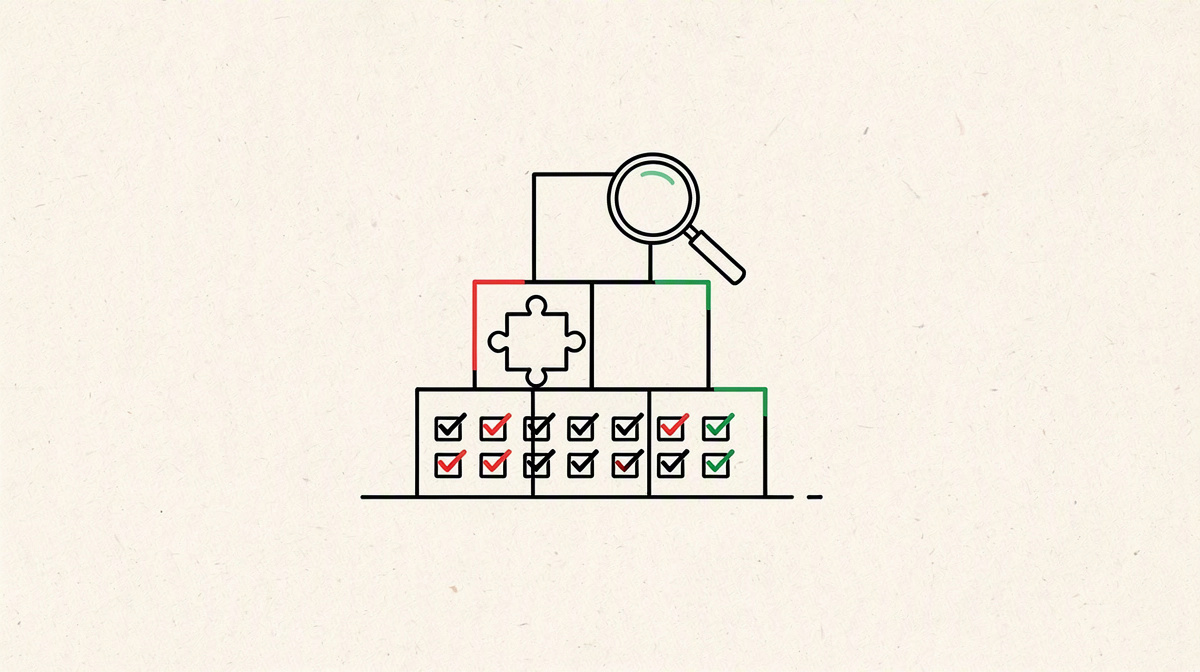
The software testing pyramid is a simple model for distributing testing effort sensibly: lots of small tests at the bottom, fewer complex tests at the top. Anyone searching for “software testing pyramid” usually wants to clarify which types of tests there are, why this distribution matters and how it can be applied in day-to-day work. For engineering leads and developers, the topic matters in two ways:
- for assessing code quality within the team
- for showing your own work in a way others can understand
That is exactly why it is worth looking not only at theory, but at real work in the repository, at the Proof Engine methodology, at the page for developers with the free repo audit and at the page for companies covering credential verification.
What the software testing pyramid means
The classic software testing pyramid organises tests according to how close they are to the code and how much effort they require. At the bottom are lots of unit tests as a broad base. Above them come integration tests. At the top there are only a few end-to-end or UI tests. So when people search for software testing pyramid, they usually mean not just a shape, but a model for distributing test types sensibly.
What matters is this: the pyramid is not a rigid law. It is a heuristic. It makes visible that cheap, fast and precise tests should be used more often than slow, fragile and expensive ones. So this is not only about quantities, but about the relationship between speed, usefulness and maintainability. Much like distinguishing between test levels in regression testing and integration testing, the model helps to describe differences more clearly.
The levels can be understood roughly as follows:
- Unit tests check small units in isolation. They help make logic errors visible early on.
- Integration tests check how components work together, for example between the application, the database or external interfaces.
- End-to-end tests look at real workflows from the user’s point of view and indicate whether critical core processes work as a whole.
The higher up a test sits in the pyramid, the greater the typical setup effort, runtime and debugging effort. That is exactly why it is a common mistake to read the testing pyramid purely as a matter of quantity. What matters is not simply “more tests”, but what kind of confidence a test creates.
For teams, the model is especially useful when explaining why not every error should be covered by a UI test. That is why anyone assessing developer work is often better off looking at real work rather than just claims in a software developer CV or a one-off take-home test format.
Why the distribution of tests matters so much for code quality
The software testing pyramid is important for code quality above all because it enables fast, useful feedback during development. When small tests fail early, teams can make changes frequently without every adjustment immediately becoming a larger risk. That is especially relevant in codebases that are continually evolving.
A broad base of tests also helps to find errors closer to their cause. A failing unit test often points more directly to a specific piece of logic than an issue that only becomes visible in a long end-to-end workflow. That does not automatically shorten every analysis, but it often makes debugging clearer and more structured.
It becomes problematic in both directions:
- If there are almost only end-to-end tests, the system often becomes more fragile.
- Small changes to the interface, test data or environment can then trigger many false alarms.
- If there are almost only unit tests, the interaction between modules, infrastructure and dependencies can easily remain under-tested.
This is exactly where the pyramid helps as a balance model: secure local logic at the bottom, test interfaces in the middle and deliberately test a few critical user paths at the top. This balance is often more meaningful than a single metric.
Because test coverage alone does not answer whether a testing strategy is good. What also matters is which risks are being checked and at which level. Anyone who takes dependencies and operational changes seriously will quickly also think about topics such as patch management explained simply.
For leads, the testing pyramid is therefore a strong communication model: it translates technical quality into an understandable picture. For developers, it makes your own contribution more tangible, much like work instead of claims: what matters is not only that tests exist, but what confidence they create.
When such statements are later checked and shared, questions about digital identity, European digital identity and pricing also become easier to understand: developers are audited free of charge, and companies pay per verification, without a subscription.
How to assess the testing pyramid in a repository in practice
Whether a software testing pyramid is really being practised is not something you see on a slide, but in a real repository. It becomes visible, for example, in test folders, file structure, build configurations and the relationship between the test types that exist. This makes it easier to judge whether unit, integration and end-to-end tests are distributed sensibly or whether one level clearly dominates.
But this only becomes truly meaningful when you include the history. What matters is not only that tests exist, but also when and how they were created. Were they developed alongside the product code? Or do they only appear shortly before a handover? This is particularly important for leads, because otherwise the testing pyramid can easily look neat without really being recognisable as a way of working.
Commit patterns also provide clues. When changes are made in small, understandable steps, the development process is usually easier to assess. If, by contrast, large blocks of code arrive in the repository all at once, that raises questions: about how they were created, about how verifiable they are, and also about how reliable the visible test structure really is.
To assess developer work, Acquispect therefore looks at the Git repository rather than the CV. The audit is structured in three stages:
- Stage A: Ghostwriter Detector analyses the
.githistory forensically: who authored commits, whether code was introduced in large blocks, and an impact score. - Stage B: Safety Check checks for leaked secrets, known vulnerabilities in dependencies, test coverage and the tech stack.
- Stage C adds a structured assessment to the technical view through five AI expert personas from the perspectives of Tech Lead, Security, Performance, Architect and Craftsman.
Especially with the testing pyramid, one point matters here: test coverage is only part of the picture. It shows how far tests reach, but not automatically whether their distribution makes sense. Only the combination of repository structure, history, commit patterns and technical review produces a more robust picture of how a developer ensures quality.
What engineering leads and developers can infer from such an audit
For engineering leads, what matters above all is whether test quality is visible as a way of working. This does not mean only whether tests exist, but whether a developer develops changes in a traceable way, safeguards them and places them in a consistent overall picture. That is often a better way to see how robust someone’s day-to-day handling of quality really is.
A good testing pyramid rarely appears as a perfect textbook pattern. More important is whether the distribution of tests fits the context:
- the product
- the architecture
- the risk profile
That turns the testing pyramid from a rigid scheme into an indication of how consciously stability and risk are being handled.
This is also helpful for developers. It allows you to show that you do not just implement features, but also take responsibility for stability, security and maintainability. In a repository in particular, it becomes visible whether that responsibility can be recognised as a pattern beyond individual commits.
The result of the audit is sealed as a W3C Verifiable Credential with did:web in the developer’s wallet. The credential belongs to the developer. When a company verifies it, it sees the verdict rather than the raw data and can also read the full audit log.
This selective verification is especially relevant for repository audits. The statement becomes usable without disclosing the entire raw body of the work. That is particularly useful when real evidence of work is needed, but not every detail of a repository should be shared.
That makes the approach a good fit for situations in which teams want to assess real developer work without necessarily relying on a traditional take-home test. The verdict remains a structured assessment with a confidence score, not simply a claim.
Frequently asked questions about the software testing pyramid
Does the testing pyramid always consist of exactly three levels?
No. The familiar representation with unit tests, integration tests and end-to-end tests is the classic form, but not a fixed law of nature. In practice, testing landscapes are often divided more finely, for example into API tests, component tests or different degrees of integration. What matters less is the exact number of levels than the basic idea behind them: many fast, precise checks close to the code, fewer elaborate checks across complete workflows.
So the testing pyramid is a model for thinking. It helps to organise test types sensibly and to avoid overweighting one expensive or fragile level.
Are lots of unit tests automatically a sign of good quality?
No, not that either. A large number of unit tests can be helpful, but on their own they say very little. What matters includes:
- whether they check relevant logic
- whether they are understandable and maintainable
- whether they provide genuinely useful feedback when changes are made
- whether the interaction between components is also safeguarded
A repository can contain a great many unit tests and still have gaps around interfaces, dependencies or real user paths. Good quality therefore shows itself not only in the number of tests, but in their distribution and in how they relate to the actual risks.
Can you really recognise the testing pyramid from a developer’s work?
Yes, at least as a pattern. It becomes visible not only in files and test folders, but also in a repository’s history. There it is possible to check whether tests have grown step by step alongside the work. Acquispect looks at the Git repository in three stages for this purpose: Stage A analyses the .git history forensically, Stage B checks test coverage among other things, and Stage C produces a verdict through five AI expert personas with a confidence score.
What is the value of a Verifiable Credential in this context?
It makes the result portable and verifiable. The verdict is sealed as a W3C Verifiable Credential with did:web in the developer’s wallet. The developer owns it. During verification, a company sees the verdict rather than the raw data and can read the full audit log. This makes a statement about test quality and work quality usable without having to disclose the entire repository.
Conclusion: The testing pyramid is a model for thinking, not a dogma
The testing pyramid makes testing strategies easier to understand because it brings together three things:
- speed
- risk
- maintainability
That is exactly why it is useful not only for architecture discussions, but also for assessing real code quality. Its greatest value emerges when it is visible in real work in the repository rather than only in statements on a CV or in an interview.
This matters for both sides. Developers can have their repository audited free of charge. Companies verify credentials as needed. The pricing model follows the same logic: developers are audited free of charge, and companies pay per verification without a subscription.
In the end, it is not the largest number of tests that convinces. What matters more is a traceable testing strategy whose result can be read as a verdict with a confidence score.